For thousands of years, cultures around the world have recognized the importance of rites of passage. Ceremonies and traditions that marked the transition from childhood into adulthood. Some involved physical challenges, others spiritual journeys, and some required facing fear, pain, or adversity. But they all served a purpose. They gave young people a sense of identity, belonging, and a place within their community.
Somewhere along the way, modern Western society decided we didn’t need these things anymore.
We replaced tradition with consumerism. Spirituality with materialism. Community with convenience. We convinced ourselves that the ancient customs of our ancestors were primitive, superstitious, or simply irrelevant to our modern world.
And what did we get in return?
A generation of young people struggling with loneliness, isolation, and a sense of disconnection from the world around them. We have more ways to communicate than at any point in human history, yet genuine human connection can feel increasingly difficult to find.
We have birthdays, graduations, driver’s licenses, and other milestones, but where is the experience that truly marks our passage into adulthood? Where is the shared challenge? The recognition? The tribe welcoming us into something larger than ourselves?
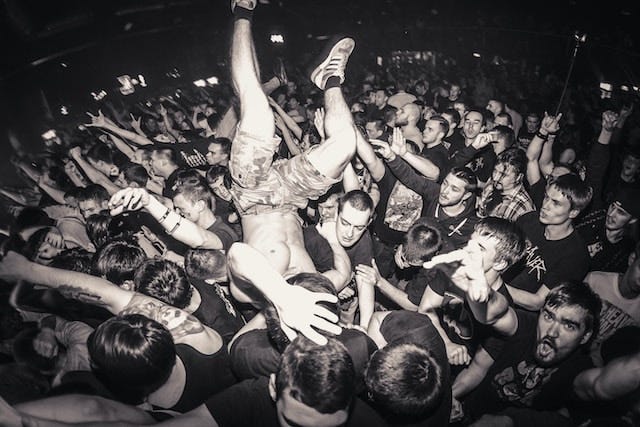
I think about this a lot when I’m at a show, particularly when I’m watching a mosh pit.
To someone unfamiliar with punk, hardcore, or metal culture, a mosh pit probably looks like a bunch of angry kids beating the hell out of each other while some band makes an ungodly amount of noise.
And sure, sometimes it can look pretty damn chaotic.
But there’s something else happening in there.
Something ancient.
Something human.
The Unwritten Rules of the Pit
There’s a certain beauty in the chaos of a mosh pit. People willingly throw themselves into a swirling mass of bodies, knowing full well they might get knocked down, bruised, or bloodied.
But there’s an understanding.
If someone falls, you pick them up.
If someone gets hurt, you help them out.
You look after each other.
It isn’t about winning or proving you’re tougher than the next person. At its best, it’s about participating in something together. Accepting a little danger, a little pain, and a whole lot of adrenaline in exchange for an experience that can’t be replicated through a screen.
And perhaps most importantly, you’re welcome.
It doesn’t matter how old you are, whether you’re male or female, gay or straight, or where you come from. If you’re drawn to the music and the culture, there’s a place for you. Sure, not every scene lives up to that ideal, but the spirit of it is there.
The music brings you together. The pit is where you become part of the tribe.
Nobody hands you a certificate. Nobody declares that you’ve passed some sacred test. But you’ve entered the chaos, shared the experience, and come out the other side.
In a strange way, you’ve participated in a modern rite of passage.
My Church Has Loud Guitars
I’ve told people for years that live music is my church.
And I mean that.
There’s something about loud guitars, pounding drums, distortion, and the collective energy of a room full of people that heals something in me. It’s cathartic. It’s energizing. Whatever I’ve been carrying around seems a little lighter after a great show.
I’ve experienced it from both sides of the stage, as a musician and as someone standing in the crowd. And while those experiences are different, there’s something spiritual about both.
The music takes over. You stop thinking about work, bills, responsibilities, and whatever else life has been throwing at you. For a little while, you’re completely present.
You’re connected to the music, the people around you, and something inside yourself that doesn’t always get much attention in everyday life.
I don’t need silence to find something sacred.
Sometimes I find it in the noise.
And when I look out at a crowd of people moving together, singing, shouting, sweating, and throwing themselves into the music, I can’t help but see a connection to the communal rituals of our ancestors.
The rhythm. The movement. The shared emotional release. The sense of surrendering yourself to something larger.
The instruments may have changed, but the human need behind the experience hasn’t.
We Didn’t Outgrow the Need. We Abandoned the Tradition.
I think one of the great mistakes of modern society has been assuming that technological and material progress somehow makes the traditions of our ancestors obsolete.
We’ve become very good at making things easier, faster, and more convenient. We’ve built a world where nearly everything can be delivered to our doorstep, streamed to our television, or experienced through a device in our pocket.
But convenience isn’t connection.
Consumption isn’t fulfillment.
And having thousands of followers doesn’t necessarily mean you have a community.
Our ancestors understood the importance of shared experiences, spiritual traditions, and the role of community in shaping an individual’s identity. Not every ancient tradition was good, and not every rite of passage deserves to be preserved. But the underlying need they addressed was real.
And it still is.
I don’t believe young people have somehow lost their desire for meaning, spirituality, or belonging. I think they’re searching for those things in a society that often doesn’t know how to provide them.
So they create their own.
They find their people in music scenes, skate parks, underground clubs, and other communities that exist outside the polished, manufactured world we’re constantly being sold.
They build their own traditions, develop their own codes of conduct, and create places where they can test themselves, express themselves, and feel accepted.
And sometimes, that place is a sweaty room with a band playing at ear-splitting volume.
Communion in the Chaos
There’s something wonderfully ironic about the mosh pit.
From the outside, it can look violent, aggressive, and even antisocial. Yet inside, at its best, there’s a remarkable sense of trust and community.
People willingly put themselves in harm’s way, knowing that the strangers around them will help them back up when they fall.
Think about that for a moment.
In a world where we’re increasingly isolated from one another, where so much of our interaction happens through screens, here are people choosing to come together physically, emotionally, and sometimes painfully, to share an experience.
They’re not buying a sense of belonging. They’re creating one.
And perhaps that’s what makes it so meaningful.
The mosh pit isn’t just an outlet for aggression or youthful energy. For those drawn to the culture, it can become a kind of initiation. A shared challenge. A moment of vulnerability and trust. A way of saying, without ever speaking the words, I’m one of you.
There’s no organized religion behind it. No ancient text or appointed spiritual leader. Just the music, the people, and the understanding that we’re all here together.
To me, there’s something sacred about that.
The Tribes We Find On Our Own
I’m not suggesting that every kid who jumps into a mosh pit is consciously searching for spiritual enlightenment or trying to recreate some ancient ceremony.
Most are probably just there to have a great time, blow off some steam, and lose themselves in the music.
And that’s perfectly fine.
But I do believe there’s something deeper happening beneath the surface.
Human beings have always needed community. We’ve always needed experiences that challenge us, transform us, and remind us that we’re part of something bigger than ourselves.
We haven’t evolved beyond those needs just because we have smartphones, streaming services, and a thousand different ways to distract ourselves.
We may have lost many of the traditions that once helped us find our place in the world, but the need for them never disappeared.
So we found our own way.
We built our own communities. Created our own rituals. Found our own tribes.
And somewhere between the crushing guitars, pounding drums, flying elbows, and outstretched hands pulling strangers off the floor, we rediscovered something our ancestors understood thousands of years ago.
That belonging isn’t something you buy.
It’s something you experience together.
And sometimes, the closest thing to communion is found in the middle of a mosh pit.